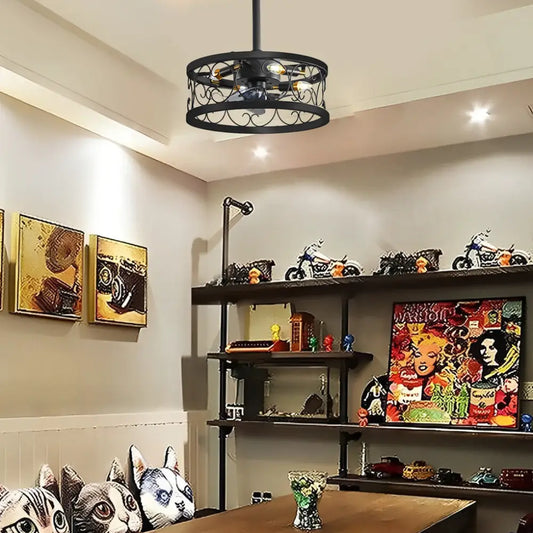
Choosing a fan design and size
Start with the ceiling silhouette you want, then measure the space the fan will occupy. A light-like appearance, a visible grille and folding blades offer different looks; the useful comparison is how the chosen design fits your room in use.
Choose the look in use
- An integrated outline: A surrounding fitting can make the fan and light read as one feature. Compare the side view as well as the view from below.
- A visible grille: An open framework makes the fan structure part of the design. Match its finish to nearby lights or furniture details.
- A changing outline: Retractable blades fold away when stopped and extend in use. Choose this look when you like a light-like appearance while the fan is off, allowing for its full operating width.
Make the shape work in the room
- Width and depth: Use overall dimensions to judge the fitting's footprint. For a rectangular or twin-fan design, measure both directions rather than relying on one size number.
- Installed height: Compare the complete drop below the ceiling, including the mounting parts. A compact-looking fitting is not automatically suitable for a low ceiling.
- Your lighting plan: Decide whether this will be the room's main light or work alongside lamps and pendants. Compare the light output as well as the decorative shape.
Which dimensions matter for your preferred design?
Which dimensions matter for your preferred design?
| Design you are comparing | Visual effect | Dimensions to use |
|---|
| Enclosed or screened fitting | Blades sit within or behind the surrounding structure | Overall width and installed drop; blade span separately if supplied |
|---|
| Open cage or grille | The framework is part of the visible design | Full outer width and drop, not just the inner fan |
|---|
| Retractable blades | A smaller outline when off, a wider outline in use | Both folded dimensions and extended blade span |
|---|
| Rectangular or twin-fan fitting | A broader shape across the ceiling | Full length, depth and installed drop |
|---|
Match the design and measurements to the version you plan to order, including its shape while running.
Back to Ventilateur de plafond sans pales
Ventilateur de plafond sans pales Questions
Does 'bladeless' mean there are no moving blades?
Not necessarily. In this collection, “bladeless” describes a range of designs, including fans with blades behind a grille, inside a cage or visible within a decorative frame. Check the product photos and specifications to see the construction of the model you choose.
Will the fan look the same when it is switched off?
An enclosed fitting generally keeps its outer shape. A retractable design changes outline as the blades fold away or extend. Compare both views if the ceiling appearance when the fan is off is a major part of your decision.
Is the listed diameter the same as the blade span?
Not always. A size may describe the outer housing or light rather than the rotating blades. Use the outer dimensions to judge the visible footprint, and the stated blade span and airflow information to compare the fan itself. For a rectangular fitting, use length and depth instead of treating one measurement as a diameter.
Can a compact enclosed fan replace a larger open-blade fan?
Start with the area you want to serve and compare the models' stated airflow or room-size guidance. A similar-looking light or a compact housing does not establish equivalent airflow. If you liked your old fan's reach, keep that performance requirement on your shortlist as well as the new appearance.
Is a bladeless-style fan a good choice for a low ceiling?
It can be worth comparing when the selected model has a suitable mounting style and installed drop. Measure from the ceiling to the fitting's lowest point, then follow the model's required clearances. Choose by those measurements rather than the word 'bladeless' or a front-view photo.
Can the fan light be the room's only light?
It depends on the light output and what you do in the room. For reading, cooking or detailed work, retain useful task lighting even if the fan supplies general light. Compare brightness, distribution and dimming before choosing a fitting as your main light.
What should I look for if the fan will be used in a bedroom?
Prioritize a comfortable lower-speed setting, convenient bedside control and separate fan/light operation. If you prefer darkness while sleeping, include display or indicator lights in your comparison. These everyday details can matter as much as the fitting's appearance.
Are enclosed fans easier to clean?
A simple outer shape may be easy to wipe, but the grille and inner blades can require different access. Before choosing, look at the manufacturer's cleaning instructions and how the parts can be reached. Stop the fan and follow the prescribed power-isolation and cleaning procedure; an enclosure does not make the fan maintenance-free.
Does a cage make it safe to touch or install within reach?
No. A cage or housing is not permission to touch moving parts or reduce the installation clearances. Keep hands and objects away, and use the installation position and clearances specified for the model. Appearance alone does not establish a child-safety rating.