
Types of Chandeliers: A Visual Guide to Shapes and Designs
In brief
Common chandelier types include candle-arm, Sputnik, branch, ring, linear, orb, globe, drum, cluster, tiered, cascade and lantern designs. Use the pictures to recognize their shapes. Names overlap: one fixture can be both linear and globe. Once you find a shape you like, compare its complete dimensions and light-source details for your room.
Key takeaways
- Sputnik arms radiate from a hub; branch designs divide into smaller forks.
- Tiered describes visible levels; cascade describes a staggered, descending arrangement.
- Shape names help you search. Dimensions, the view from below and light-source details help you choose.
1. 12 chandelier types, with pictures
Use the pictures below to recognize the shapes and find designs you like.
Illustrations show example designs, not specific products for sale.
Candle-style / Candelabra

Candle-style lights sit on arms extending from a central body. The open arrangement makes the individual lights part of the look.
Sputnik

Straight rods radiate from one central hub to create a starburst. Compare its full span, including arms that project toward you.
Branch

The frame divides into smaller branches. This example resembles a tree branch, but other designs use smooth, geometric forks.
Ring

One or more rings form the main body. A single ring creates a simple outline; stacked or tilted rings create a more layered look.
Linear

Lights extend along an elongated frame. Compare its long outline over a rectangular table or island, checking both length and width.
Orb

An open, roughly spherical frame surrounds the lights. Its curved outline has depth, so compare a side view as well as the front.
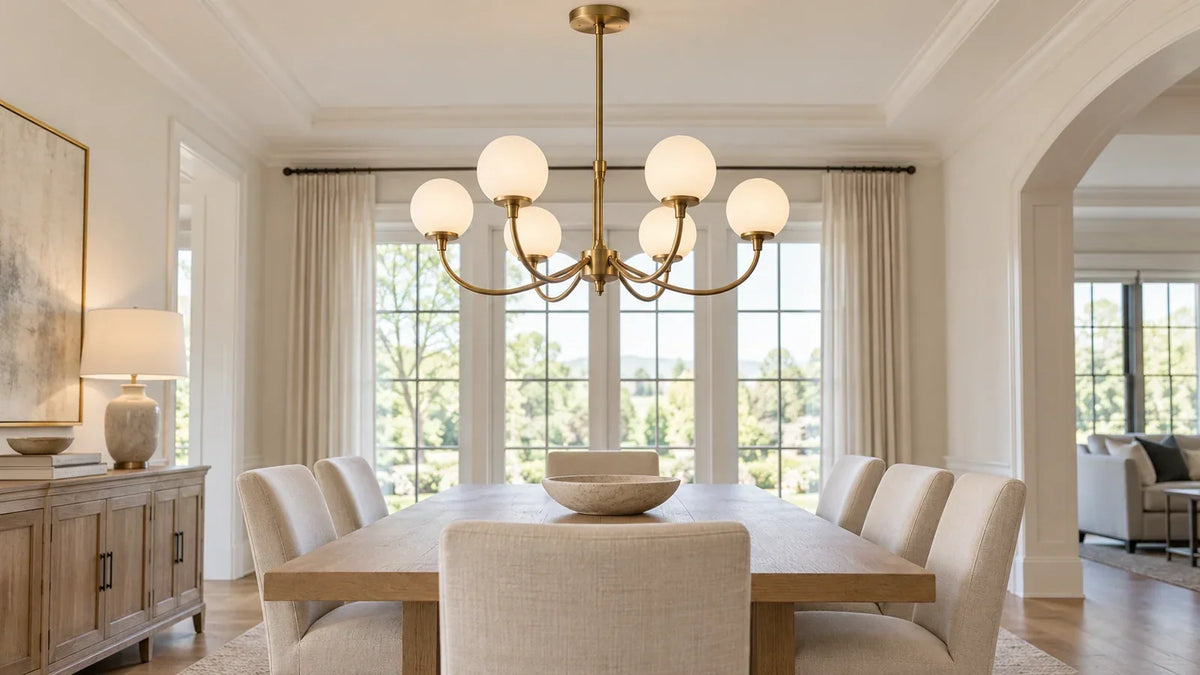
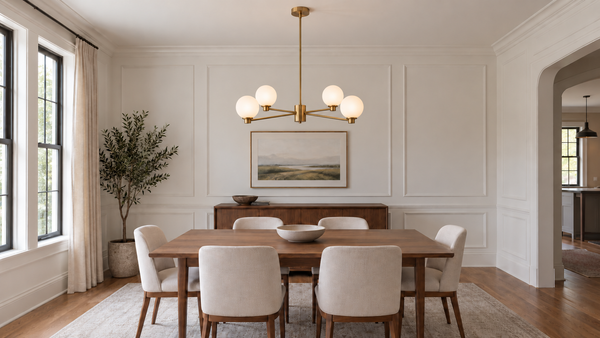
Globe

Globe often describes spherical shades on a frame. Some sellers also use it for an overall round shape, so check the photos.
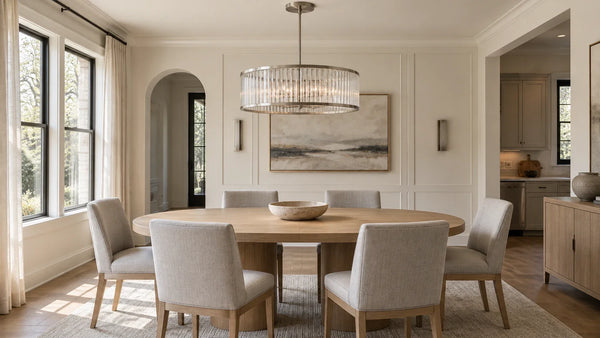
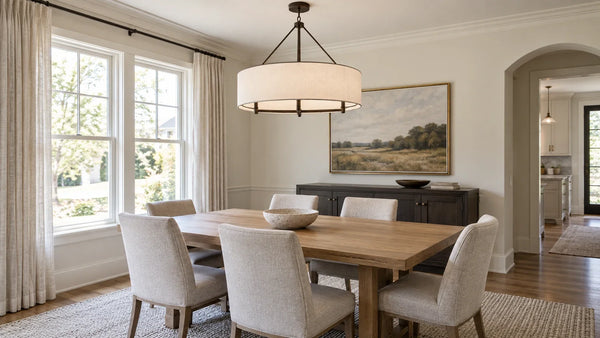
Drum

A broad cylindrical shade or body creates a drum outline. Check the underside if you want the bulbs hidden from your seat.
Cluster

Several lights form a close group beneath a shared canopy or on a frame. The group may also cascade if its drops descend at staggered heights.
Tiered

Two or more visible levels form the body. This candle-style example adds vertical presence; compare the full body height.
Cascade

Lights or ornaments descend at staggered heights. Compare the full drop and outline, especially when viewing it from an upper landing.
Lantern

A lantern-like frame surrounds the lights, sometimes with glass panels. Its defined outline can be open or enclosed; compare the depth as well as the width.
2. Similar names, different shapes
Compare the feature each word describes—arms, shades or arrangement—rather than treating every label as a separate type.
| Names | The useful distinction | What to check |
|---|---|---|
| Ring / orb / globe | A ring is circular; an orb often forms a spherical frame; globe often refers to a spherical shade. | Check the whole body and individual shades. Retailers may use orb and globe interchangeably. |
| Sputnik / branch | Sputnik rods radiate from a hub; a branch design divides into smaller connected sections. | Trace the connections. Ball-shaped bulbs alone do not distinguish them. |
| Drum / shaded | Drum describes a cylindrical silhouette. Shaded describes lights with shades of many possible shapes. | A chandelier with several small shades does not have to be a drum. |
| Tiered / cascade | Tiered emphasizes visible levels; cascade emphasizes an arrangement descending through space. | Some fixtures have both. Compare the full hanging body rather than treating the names as opposites. |
A wagon-wheel chandelier is another useful example: its horizontal wheel may support candle-style lights, so it can also be described as candle-style. An illuminated ring and a wheel carrying separate lamps can look quite different even though both have circular outlines.
3. Why chandelier names overlap
One fixture can have several useful labels: linear describes its long arrangement, globe its spherical shades, and modern its style. A finish such as brass-tone adds another detail. For modern, traditional and other room looks, compare our visual guide to chandelier styles.
To compare the surfaces and finishes used in these shapes, see our chandelier materials guide.
Crystal and beaded describe decorative materials or elements; floral, antler and geometric describe recognizable forms. Empire commonly describes strands rising toward a narrower top above a fuller lower body. If crystal is on your shortlist, use our crystal chandelier buying guide to compare appearance, details and upkeep.
Mini describes relative size; island and billiard describe settings. Flush and semi-flush describe mounting close to the ceiling. Use the actual dimensions to judge fit.
One connected fixture or several separate pendants?
A linear chandelier often carries several lights on one connected body. Separate pendants have their own hanging bodies and may have separate ceiling mounting points. A shared canopy can also support multiple drops. Look at the canopy and connections to understand what is supplied and what your layout requires.
4. Choose a starting point for your room
Use these shapes as starting points, then compare the actual fixture with your furniture, ceiling and viewing position. Several types can work in the same room.
| Your setting | Shapes to compare and what to check | Next step |
|---|---|---|
| Dining table | Start with linear designs for a long table, or centered forms such as candle-style, globe or drum for a round table. Compare the complete dimensions with your everyday table layout. | Dining room selection guide; linear length and width guide. |
| Kitchen island | Compare one linear fixture with separate pendants. Check work areas, seating and the ceiling mounting points. | Island size, height and spacing guide. |
| Bedroom or living room | Compare drum, globe or open-arm designs for the look you prefer. Check the view from the pillow or sofa; a shade does not necessarily hide bulbs underneath. | Bedroom guide; living room guide. |
| Foyer or staircase | Compare tiered or cascade designs for a tall space, or lantern forms for a defined outline. Check width, drop, upper-level views and walking routes. | High-ceiling, foyer and staircase guide. |
| Limited ceiling height | Compare shorter-bodied designs and flush or semi-flush alternatives. Use the actual installed height to judge the space beneath. | Hanging-height guide. |
5. What to check before ordering
- Complete dimensions: include the outermost arms, shades and ornaments. Check the body height and total installed drop. Use the chandelier size guide to compare proportions.
- Your view of the lights: inspect underside photos. Consider what you will see while seated, standing or lying down, including any exposed lamps.
- Light source and controls: confirm whether the selected model uses replaceable bulbs, integrated LEDs or serviceable modules. Check the manufacturer’s dimming requirements and compatible controls.
- Care and access: consider how you will reach shades, hanging pieces and light sources. Ask about cleaning instructions, replacement parts and servicing before ordering a difficult-to-reach fixture.
Save the dimension drawing for your chosen configuration. A beautiful room photo can help you picture the design, while the model’s own specifications establish what you are buying.
FAQs
What is the difference between a chandelier and a pendant?
The terms overlap in retail listings. Chandelier often describes a decorative fixture with multiple lights or a connected body; pendant describes a suspended light and can also have several lights. Check the actual canopy, body and light arrangement.
Will a shade hide the bulbs when I look up?
That depends on its shape, depth and any bottom diffuser. A shade can conceal the lamps from the side while leaving them visible underneath. Ask for an underside photo if that view matters to your room.
Can I tell whether the bulbs are replaceable from the shape?
No. Similar-looking fixtures can use different light-source systems. Check the selected model’s specifications for bulb type or LED service details, and ask how replacement parts are obtained.
Can I use a chandelier with a low ceiling?
Possibly, depending on its complete installed dimensions and location. Compare the mounting options and the space needed beneath the fixture using our hanging-height guide, then confirm installation requirements for the chosen model.
Sources
- Arteriors: Types of Chandeliers — reference for common form and style terminology.
Comments
Have a question or a useful tip? Leave a comment below.