
How to Choose a Living Room Chandelier
In brief
Start with the seating area and available hanging space. An open frame can feel lighter; a broad shade gives a fuller outline. Check the view from the sofa, plan a separate reading light where needed, and choose controls that suit the exact chandelier option.

Key takeaways
- In an open-plan room, start with the seating group rather than the center of the entire space.
- Limited hanging space? Compare shallow flush or semi-flush designs by their complete installed height.
- Open arms leave more visible space; a broad shade creates a fuller outline.
- Check shade openings from the sofa, and plan reading light near the reading seat.
- Remote dimming does not automatically work with a wall dimmer.
Start with the seating area and everyday activities
A balanced, enclosed living room may suit a central chandelier. In an open-plan space, start with the seating group. Sketch the sofa, coffee table, television and walking routes before choosing the hanging point.
- Watching television: check whether bright bulbs would appear in your view or reflect in the screen.
- Reading: add light near the reading seat, so the chandelier does not have to do every job.
- Conversation: compare a comfortable general light level, with compatible dimming for flexibility.
The room center, coffee table and existing ceiling connection may not align. Settle the furniture layout first; ask an installer about any change to the connection.

Check how much hanging space you have
With limited space, compare flush mounts that sit close to the ceiling and semi-flush designs that hang a short distance below it. A suspended chandelier gives more hanging options where height allows. Check the minimum installed drop—the distance from the ceiling to the light’s lowest point, including its ceiling plate, rods or chain, and light body.
Height above the floor = ceiling height − complete installed drop
Example: 108 − 24 = 84 in above the floor. This calculates the lowest point, not an approved clearance.
Measure vertically at the hanging position and include the lowest decorative part. Check walking routes and places where people stand up; a coffee table underneath does not settle the clearance question. For a sloped ceiling, confirm the model’s mounting method and hanging range.
Use our height guide and calculator for the measuring steps. If space is tight, compare flush-mount and semi-flush options by their actual depth.
Choose a size and outline that work with your furniture
Decide whether you want a quiet addition or a focal point. Open arms usually look lighter than a continuous shade, even when their outer widths are similar. Compare the complete width, length and body height against your seating group.

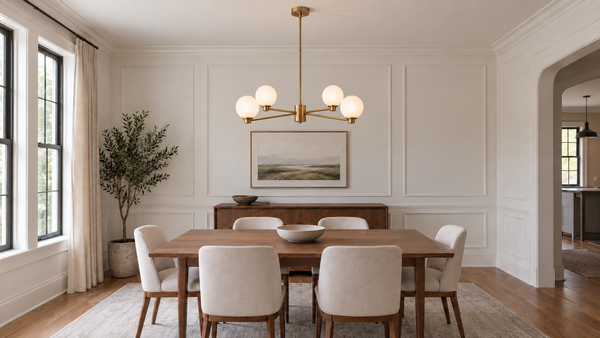
Open-arm chandelier
Distinct arms and opal glass shades leave visible space between the lights.

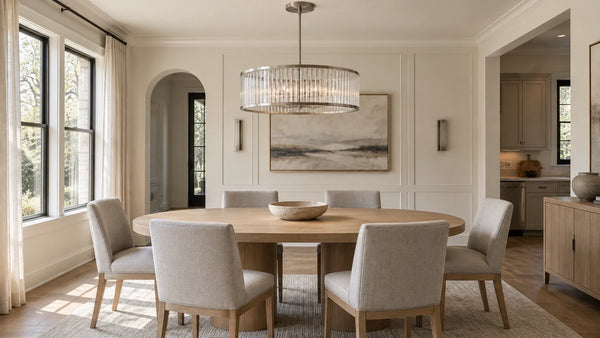
Broad fabric shade
A continuous outline with a fuller appearance.
| Your starting point | Try comparing |
|---|---|
| Patterned furniture or a busy room | A simple, open outline that leaves more of the room visible. |
| A quiet room needing a focal point | A broad shade or more distinctive shape, checked from the doorway and sofa. |
| A long seating arrangement | Round and elongated designs; check the full reach and direction of projecting arms. |
| Little space below the ceiling | Shallow designs with a suitable complete installed height. |
These are starting choices, not fixed style rules. Mark the full footprint on paper or on a room photo, then compare two candidates. Our chandelier size guide helps you narrow the dimensions.
For the finish, pick up a detail such as a table base or lamp if you want an easy connection. Everything need not match. Close-up photographs help distinguish polished metal, brushed metal, glass and fabric.
Look at the light from your usual seat
Check the fixture from the sofa as well as the doorway. Shade openings can reveal bulbs or LED surfaces from below. If a bright source would be directly visible, compare designs that screen it and offer suitable brightness control.

Sit where you watch television or read and photograph the proposed position. Ask for a lit, low-angle photograph of the candidate chandelier to see its openings and light sources. Photographs help with shape and visibility; check actual glare in your room.
Notice reflections from your existing light on a dark television screen. A replacement may behave differently, so check its position and everyday lighting arrangement after installation.
For reading, keep a table or floor lamp close to the seat. For general light, compare documented lumens—the amount of light—rather than watts or bulb count. Distinguish a complete fixture’s output from the sum of its bare bulbs. Brightness reference.
Choose the light color and controls you want to use
Compare the chandelier’s stated light color with nearby table or floor lamps. Similar color temperatures can give a coordinated look; a deliberately different light color may suit a different activity. Photographs alone cannot confirm the match.
| What matters to you | What to check |
|---|---|
| Easy light-source replacement | For bulbs: type, limits and access. For integrated LED: which parts are replaceable and how to obtain them. |
| Changing brightness or light color | The functions of the exact option you select. |
| Using an existing wall dimmer | A documented compatible pairing with the bulbs or LED electronics. Remote dimming is a separate function. |
Confirm the controls before ordering, especially if you want to keep an existing dimmer. Compatibility reference.
Confirm the shortlist before ordering
- Fit: complete outer dimensions and minimum/maximum hanging distance.
- Chosen option: finish, light source, supply voltage and supported controls.
- Included parts: bulbs, remote and suspension parts, where applicable.
- Installation and care: support, fixture weight, cleaning and replacement access.
Send the seller your ceiling height and seating-area photographs with the exact option you are considering. Have the installer confirm mounting suitability.
Living room chandelier FAQs
Should a chandelier be centered on the room or the coffee table?
Use the long-term furniture layout as your starting point. A balanced enclosed room may suit the room center; an open plan may suit the seating group. Check walking routes and the ceiling connection before deciding on a position.
Can I use a chandelier in a low-ceiling living room?
Possibly. Compare the fixture’s complete minimum installed height with the clearance your room needs. Flush and semi-flush styles are worth exploring, but their actual depth still matters. Check the lowest projecting part, including shades or decorative drops.
Is a dimmable chandelier always compatible with my wall dimmer?
No. Compatibility depends on the selected bulbs or LED driver and the control system. Ask for the supported dimmer details for the exact configuration. Remote dimming alone does not establish compatibility with a wall dimmer.
Can one chandelier provide all the light a living room needs?
It depends on its output, light distribution, the room and your activities. A chandelier may provide general light while a reading seat needs its own task light. Consider those uses separately rather than choosing by bulb count alone.
Should I choose replaceable bulbs or integrated LED?
Choose replaceable bulbs if being able to change the bulb yourself is a priority, subject to access and the fixture’s permitted bulb specification. For integrated LED, compare the design with the service arrangements: ask which parts can be replaced and how replacements are obtained.
Sources
- ENERGY STAR: Learn About Brightness — explains lumens as light output and watts as power use.
- Lutron: LED Compatibility Resources — illustrates why a dimmable LED and a wall dimmer need a documented compatible pairing; it does not confirm compatibility for a Toplightstore product.
Back to Ultimate Guide to Choosing the Perfect Chandelier for Your Home
Comments
Have a question or a useful tip? Leave a comment below.